Social Media Trends, Social media does not stay still. The strategies that drove real results two years ago are producing weaker outcomes today. The platforms that dominated attention in 2022 are sharing it with newer platforms in 2026. And the type of content that earns engagement has shifted in ways that caught many marketers off guard.
Brands that stay aware of where social media is heading make better decisions about where to invest their time, their content, and their budget. Brands that keep running the same playbook from three years ago are seeing their reach decline and their engagement drop, often without understanding why.
This guide covers the eight social media trends that are shaping how marketing works in 2026. Each one is grounded in what is actually happening on the platforms right now, and each one comes with a practical implication for how your brand should respond.
Trend 1: Short-Form Video Is No Longer Optional for Any Brand
Short-form video has been growing for several years, but in 2026 it has moved from a trend into a baseline expectation. TikTok, Instagram Reels, YouTube Shorts, and LinkedIn video content are all part of a consistent pattern: audiences across every age group and professional category now consume more short video content than any other content format.
This shift is not purely a consumer behaviour story. The algorithms on every major platform now actively reward short video content with organic distribution that static images and text posts cannot compete with. A brand that publishes short video content consistently reaches more people organically than one relying entirely on images, regardless of how strong that image content might be.
According to HubSpot’s State of Marketing 2026 report, short-form video delivers the highest ROI of any social media content format for the third consecutive year. That consistency is not a coincidence. Platforms are designed to surface video content because video drives session time, and session time is what the platforms sell to advertisers.
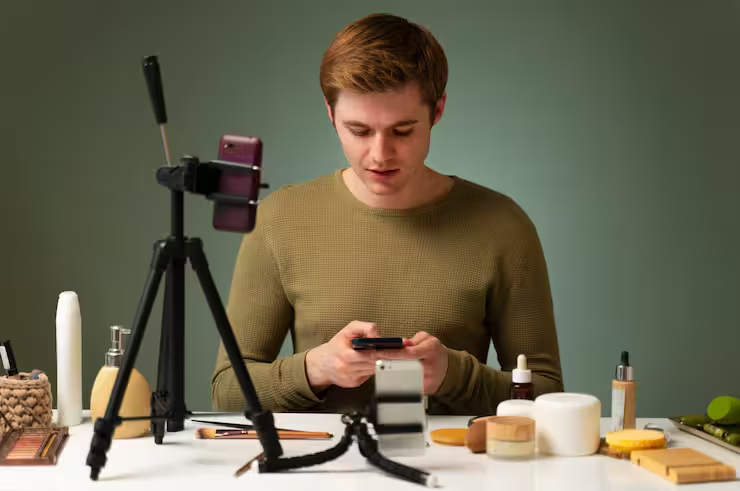
The practical implication for brands is not that every piece of content needs to be a professionally produced video. Some of the best-performing short-form content on every platform is filmed on a phone with natural lighting and straightforward editing. Authenticity in the delivery often outperforms production value. What matters is the idea, the relevance to the audience, and the ability to communicate something worth watching in under 60 seconds.
If your brand is not yet publishing short-form video, starting in 2026 is not early. It is already catching up.
Trend 2: Social Media Is Becoming How a Generation Searches for Information

Google remains the dominant search engine by a significant margin, but how younger audiences find information is changing in a way that marketers cannot ignore. A growing proportion of people, particularly those under 35, use TikTok, Instagram, and Pinterest as their first point of search for product recommendations, how-to content, restaurant choices, travel inspiration, and service providers.
This behaviour shift has a direct implication for how brands need to think about social media content. Content that is optimised for discovery within social platforms, through clear language in captions, keyword-relevant descriptions, and topic-specific hashtags, now needs to function as search-optimised content in the same way that website content needs to function for Google.
Brands that understand this are building social content libraries that answer the specific questions their target audience asks on social platforms. A food brand that publishes recipe content using the same language someone would type into Instagram search captures discovery intent from buyers who are not searching Google at that moment. A professional services firm that publishes answers to common client questions on LinkedIn captures prospects at the research stage without paid advertising.
Sprout Social’s 2026 Social Media Trends research identifies social search as one of the most significant platform behaviour changes currently underway, with brands that adapt their content strategy to account for in-platform search seeing measurably stronger organic reach than those treating social media purely as a distribution channel for pre-existing content.
Trend 3: AI-Generated Content Is Everywhere, and Authenticity Is Winning Because of It
AI content creation tools have made it possible to produce social media posts, captions, graphics, and even video scripts at a scale that was impossible two years ago. The result is a social media environment where the volume of content being published has increased dramatically while the proportion of it that feels genuine and specific has decreased.
This is creating a counterintuitive opportunity for brands willing to show up authentically. In a feed full of AI-polished captions that could have been written for any business in any industry, content that clearly comes from a real perspective, a real team, a real experience, or a real customer story stands out in a way that was harder to achieve when everyone was working from the same starting point.
Audiences are also becoming more perceptive about the difference. Generic AI-generated content produces a pattern of language and structure that regular social media users are beginning to recognise and discount. Content that contains specific details, genuine opinions, named individuals, real numbers, and actual stories from inside the business earns engagement that generic content cannot replicate.
The strategic response to this trend is not to avoid AI tools entirely. It is to use them to speed up production processes while keeping the specific, human, brand-specific perspective in the content that the tools cannot generate. AI can draft a caption. Only your brand can add the specific customer result, the behind-the-scenes detail, or the genuine opinion that makes that caption worth reading.
Trend 4: Social Commerce Is Maturing Into a Primary Revenue Channel
Social commerce, which is the ability to discover and purchase products directly within a social media platform without leaving to visit a separate website, has been developing for several years. In 2026, it is mature enough to be a primary revenue channel for product businesses rather than an experimental addition to their marketing mix.
TikTok Shop has grown rapidly as a commercial platform, particularly for brands with products that demonstrate well in short video. Instagram and Facebook Shops allow product catalogues to be browsed and purchased within the app. Pinterest has integrated shopping features that allow recipe ingredients, home decor items, and fashion products to be purchased directly from the pin.
For brands selling physical products, the friction reduction that social commerce offers is commercially significant. The fewer steps between a buyer seeing a product and completing a purchase, the higher the conversion rate. Social commerce removes the step of navigating from a social platform to a website, which research consistently shows reduces dropout rates in the purchase journey.
Brands that have already integrated social commerce into their strategy report that TikTok Shop in particular drives strong impulse purchase behaviour from audiences that were not actively searching for their product category. A compelling short video demonstration of a product in use leads directly to a purchase option within the same content experience, which is a fundamentally different commercial dynamic than traditional e-commerce.
If you sell physical products, establishing your social commerce presence on the relevant platforms in 2026 is approaching the point where it will become a competitive necessity rather than a strategic advantage.
Trend 5: Community-Led Growth Is Outperforming Pure Broadcast Marketing
Broadcasting content at an audience is becoming less effective as a standalone strategy. The brands growing the fastest on social media in 2026 are building communities around shared interests, challenges, or identities rather than simply pushing content at followers.
Community-led growth means creating spaces where your audience interacts with each other and with your brand, not just consuming your content individually. Facebook Groups built around a specific interest related to your brand’s category. Discord servers for customers of a specific product type. LinkedIn newsletters that generate regular reader responses. Instagram close friends lists for highest-value audience segments.
When people feel they belong to a community that happens to be associated with your brand, the relationship they have with your business becomes significantly more durable than the relationship created by passive content consumption. Community members are more likely to purchase, more likely to recommend, more likely to defend the brand publicly, and less likely to be swayed by competitors.
According to Buffer’s research on social media engagement patterns, brands that actively build and manage communities around their social media presence see engagement rates three to five times higher than those focused purely on content broadcasting. High engagement rates signal platform algorithms that the content is worth distributing, which compounds into broader organic reach without additional spend.
The investment in building a community is upfront and requires consistent attention. The return, measured in customer loyalty, word-of-mouth growth, and the genuine advocacy of community members, compounds over time in ways that broadcast-only strategies rarely produce.
Trend 6: Employee Advocacy Is Becoming a Legitimate Brand Channel
One of the most underused social media assets that most businesses already have is their team. Employees who share genuine content about their work experience, their professional perspective, and their company culture on their personal social media accounts generate a type of reach and credibility that branded content cannot match.
People trust content from people more than content from brands. When an employee of a company posts about a project they are proud of, a customer outcome they helped deliver, or an aspect of their work culture they genuinely value, that post reaches a network of people who do not follow the brand account and who are predisposed to find the content credible because it comes from a real person rather than a corporate account.
In 2026, forward-thinking businesses are building structured employee advocacy programmes rather than leaving this to chance. They are giving team members the tools, the encouragement, and the content support to share professional content on LinkedIn and other platforms. They are recognising that the combined reach of their team’s professional networks is often larger than the brand’s own social media following, and that content shared through those networks carries trust that branded content cannot buy.
Employee advocacy is particularly powerful on LinkedIn, where professional content shared by individuals consistently outperforms the same content posted from company pages in terms of organic reach. A post shared by a named professional reaches their network with a credibility signal that a company page post simply does not carry.
Trend 7: LinkedIn Has Evolved Into a Content Platform Every Industry Should Take Seriously
LinkedIn used to be primarily a platform for job searching and professional networking. In 2026, it is a genuine content platform where thought leadership, educational content, industry commentary, case studies, and brand storytelling all earn significant organic reach from audiences that are difficult to reach through any other channel.
The LinkedIn algorithm in 2026 actively rewards content that generates comments and conversations rather than passive likes. Content that asks a specific question, shares a contrarian view, presents a surprising result, or tells a story with a professional lesson at its centre consistently outperforms content that simply announces information.
For B2B businesses in particular, LinkedIn represents a unique opportunity. The targeting precision available through LinkedIn Ads, which allows campaigns to reach specific job titles, industries, company sizes, and seniority levels, is unmatched by any other platform for B2B buyer audiences. And the organic content on LinkedIn reaches those same audiences without the advertising cost, making consistent organic content publishing one of the most cost-effective B2B marketing activities available.
Businesses in professional services, technology, manufacturing, healthcare, education, and financial services all have relevant audiences actively consuming content on LinkedIn daily. The brands that publish consistently on the platform are building authority and relationships with buyers who research suppliers extensively before making contact.
The relationship between LinkedIn organic strategy and broader digital marketing efforts, including how content authority supports SEO visibility and paid campaign performance, is part of the integrated approach that Mark X Media’s services are built around.
Trend 8: User-Generated Content Earns Trust That Brand Content Cannot Manufacture
User-generated content, which is any content created by customers or community members about a brand rather than by the brand itself, has become the most trusted content type on social media. Reviews, testimonials, unboxing videos, customer photos, and honest experience posts from real buyers carry a level of credibility with audiences that polished brand content simply cannot replicate.
Research from Oberlo on social media marketing statistics shows that consumers find user-generated content 2.4 times more authentic than content created by brands. That trust differential has a direct commercial impact. Buyers who see real customer content about a product or service are significantly more likely to complete a purchase than those who see brand-produced content alone.
The strategic response to this trend is to actively encourage and systematically collect user-generated content. Asking customers to share their experience on social media after a purchase. Creating a branded hashtag that makes it easy to find and reshare customer content. Featuring real customer photos and reviews prominently in your social media feed. Highlighting specific customer stories with their permission in your content.
Resharing authentic customer content serves two purposes simultaneously. It provides the social proof that converts hesitant buyers, and it acknowledges and rewards the customers who created it, which encourages more of them to do the same. A consistent flow of genuine customer content is self-reinforcing when it is actively nurtured.
How to Apply These Trends Without Overstretching Your Resources
Eight trends is a lot to absorb at once, and trying to implement all of them simultaneously without a clear strategy is a reliable way to spread resources too thin and produce mediocre results across all of them.
The practical approach is to audit where your brand currently stands and identify which two or three of these trends represent the highest-impact opportunities for your specific audience and business type.
A consumer product brand selling physical goods should prioritise short-form video and social commerce because those two trends together represent the most direct path to increased revenue from social media. A professional services firm should prioritise LinkedIn content and employee advocacy because those channels reach B2B decision-makers most effectively. A brand with a strong existing customer base should prioritise user-generated content and community building because those strategies produce the highest return from resources that already exist.
The Mark X Media project portfolio shows how these strategic priorities are applied differently across business types and industries, which can help you identify the most relevant starting point for your brand specifically.
What to Stop Doing Based on Where Social Media Is Heading
Understanding where social media is going also makes it clear what is becoming less effective and where continued investment produces diminishing returns.
Posting static images as the primary content format without any video component is losing ground on every platform as algorithms de-prioritise non-video content. Buying followers or engagement through services that deliver fake accounts continues to damage reach because platforms actively suppress accounts that show signs of artificial inflation. Publishing content on every platform simultaneously without adapting it to the native format and audience of each platform produces content that feels out of place everywhere rather than intentional anywhere.
Treating social media as a broadcasting channel with no engagement with comments, replies, or community activity misses the shift toward conversation-driven growth that is defining the most successful brand accounts in 2026. And ignoring analytics while continuing to post the same content mix regardless of what the data shows about what your specific audience responds to wastes the insight that every platform makes available at no cost.
Effective social media marketing in 2026 connects directly to your broader digital marketing strategy. Mark X Media’s SEO optimization services and performance advertising services both work most effectively when supported by a strong, current social media presence built around the trends driving engagement and growth right now.
Social Media in 2026 Rewards Brands That Stay Current
The brands holding the strongest social media positions in 2026 are not necessarily the ones with the largest budgets or the biggest existing audiences. They are the ones that understood where the platforms were heading before their competitors did and built their content and community strategy around those directions.
Short-form video, social search, authentic content, social commerce, community building, employee advocacy, LinkedIn, and user-generated content are the eight areas where attention and investment produce the strongest returns right now. Pick the two or three most relevant to your business and build toward them with consistency.
Social media growth is not fast, but it is durable when it is built on the right foundations. The strategies your brand establishes this year will compound into a significantly stronger position by next year, and the year after that.