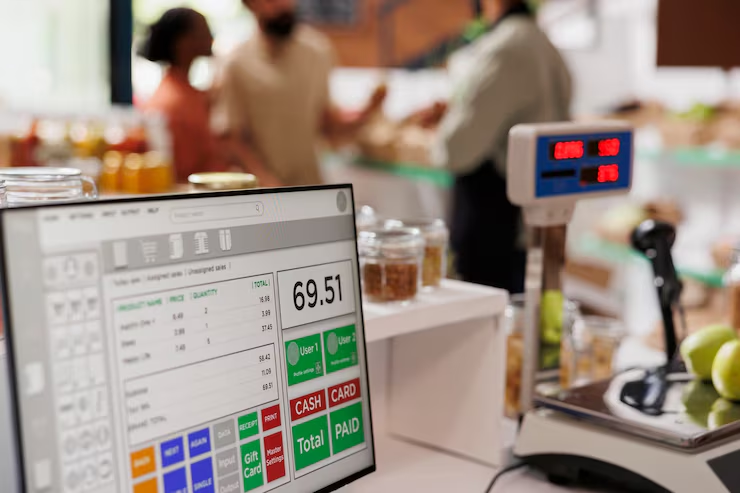
FBR POS Integration. Pakistani retailers in 2026 are operating under a tax compliance framework that has changed significantly in the past two years. The Federal Board of Revenue now requires covered businesses to connect their point-of-sale systems directly to the FBR server and transmit every sale in real time. This is not a future requirement or a pilot program. 1For retailers, restaurants, and many service businesses in Pakistan, this integration is no longer optional — it is a legal requirement.
This guide covers who must comply, what your software must be able to do technically, which documents you need before you start, and how to get from registration to go-live without getting stuck.
Who Is Required to Integrate: Tier-1 Retailer Definition
2 Under the Income Tax Ordinance 2001, Tier-1 retailers are required to integrate their POS with the FBR central system for real-time reporting of sales tax. 2 The Sales Tax Act 1990 defines Tier-1 retailers. 2 The following businesses qualify as Tier-1 retailers: official retail outlets of national and international brands and their chain of stores, retail franchises and authorized retailers of national or international brands, and retailers selling in air-conditioned shopping malls, plazas, or centers, not including kiosks. 2 A retailer whose total electricity bill during the immediate last 12 months exceeds PKR 1,200,000 also falls under this definition. 2 Any shop, store, or retailer that accepts State Bank-approved online payments and digital transactions, debit cards, and credit cards is also included. 5 Smaller retailers who do not meet the Tier-1 criteria are not required to implement real-time point-of-sale integration. However, they are still required to issue FBR-registered invoices for their sales and to file monthly returns. 7 The FBR is progressively expanding coverage to include more SME categories. 4 Even if your business is not technically Tier-1 today, FBR-formatted receipts are increasingly being treated as a quality signal by customers and corporate buyers. Most serious Pakistani retailers are voluntarily upgrading to FBR-formatted receipts in 2026.
What FBR POS Integration Actually Does
9 FBR POS integration is not merely software installation. It is a real-time connection between your point-of-sale system and FBR’s Pakistan Revenue Automation Limited (PRAL) database, automatically transmitting every sale in real-time and generating an Invoice Record Number (IRN) with a QR code on each receipt. 11 The FBR POS system is built around six features: registration of every point of sale, real-time transmission of invoice data, central generation of a unique FBR invoice number, a customer-verifiable QR code, controlled offline handling, and continuous monitoring by FBR. 13 FBR stamps each invoice with a unique 22-character IRN made up of the business NTN, document type, and timestamp. The QR code on every receipt encodes the IRN, NTN, date, total amount, and FBR verification URL. 5 Your monthly sales tax return must be consistent with the transaction data transmitted through your POS. There is no room for discrepancies because FBR already has the raw data. 5 One important benefit that came with the Tier-1 integration requirement is that large retailers who join the integration system are entitled to claim input tax credits on their purchases. Previously, many retailers operated under a simplified scheme where they paid a fixed tax but could not claim input tax. Integration unlocks the credit mechanism.
Pre-Integration Checklist: Documents and Business Readiness
Before you approach a software vendor or licensed integrator, you need several things in order. 8The retailer must have a valid National Tax Number (NTN) and a Sales Tax Registration Number (STRN). If not already registered, apply through FBR’s IRIS Portal.11 The full pre-integration document checklist includes: NTN certificate, active STRN, CNIC of proprietors, directors, or partners, incorporation or registration documents such as an SECP certificate, partnership deed, or sole proprietorship evidence, and a bank account maintenance certificate. You also need proof of business premises for every outlet, whether an ownership document or tenancy agreement, and the latest electricity bill for each outlet.
On the business operations side, 11prepare a complete list of outlets with addresses, a complete count of payment counters at each outlet, website or mobile app details if you sell online, an item master with correct tax rate mapping for every SKU, documented discount, promotion, and loyalty logic, and a documented returns, exchange, and credit-note process.
Software Requirements: What Your POS Must Be Able to Do
8 Your POS software must comply with FBR’s technical requirements: the ability to generate electronically verifiable invoices, real-time communication with FBR’s servers, secure transmission of invoice data, and proper user authentication. 3 Invoices must have a unique identification number. The FBR tax invoice number, FBR logo, and FBR verification QR code must be printable on each invoice. Customers must be able to verify invoices via SMS or WhatsApp. Data transmission from POS to FBR must be encrypted. The POS must accept credit and debit cards. Digital signatures of the taxpayer must be printable on the invoice. 14 The system operates through Pakistan Revenue Automation (Pvt) Limited (PRAL) and is built on the DI API v1.12, which handles all invoice data validation and submission. Your POS software must natively support this API version. 12 This means native capabilities to generate, structure, and securely transmit required JSON payloads directly to the FBR’s API servers without intermediate manual steps.
The mandatory data fields your POS must transmit with every transaction include the seller’s NTN and STRN, a unique invoice number in the standard format, the date and time of sale, an itemized breakdown with each product’s name, quantity, unit price, and applicable tax rate, the total sales tax amount, and the IRN returned by FBR after validation.4 An FBR-compliant receipt must contain your business name as registered with FBR, your NTN, your STRN, your POS registration number issued by FBR after integration, the FBR invoice number in the standard STRN-DDMMYYHHMMSS-sequence format, the date and time of sale, an itemized breakdown with each product’s name, quantity, unit price, and total, and a sales tax breakdown showing the GST amount per item or in total.
Beyond the core fields, your software should support multi-tax rate handling, since different product categories carry different GST rates, and provincial tax body requirements for SRB, PRA, KPRA, and BRA where applicable.
Minimum Technical Requirements for the Integration Environment
3 The minimum system requirements for the integration environment are Microsoft Windows OS version 7 and above, Internet Information Services (IIS) installed, and .NET Framework 4.5 or above. 9 Real-time IRN generation requires continuous internet connectivity. A reliable broadband connection of at least 2 Mbps upload speed is recommended for smooth operation. Internet outages trigger offline handling protocols.
Offline handling is a non-negotiable feature for any POS software in Pakistan. Power cuts and internet disruptions are real operational risks. 13Your POS must handle offline queuing when internet drops and auto-sync when the connection returns. 5You must keep your POS system running and connected during all business hours. Offline periods where transactions are not transmitted create compliance gaps.3 The installation user must have administrator rights on the machine running the fiscal software component. 3 FBR’s fiscal software is available for download from the FBR website.
A QR-capable receipt printer is also required at every counter. The printer must support the resolution needed to generate a scannable QR code on a standard receipt. Low-resolution thermal printers may print QR codes that fail customer verification scans.
The Eight Licensed Integrators: Your Only Legal Route
This is a point most retailers miss. 9You cannot self-integrate. Your POS or ERP system must connect to FBR through one of the eight licensed integrators: PRAL, which is free of cost, Haball, WebDNAworks, EY Ford Rhodes, OpenPort Pakistan, TMR Consulting, NatureTech, or Dynamic Resources.13 FBR does not approve specific software brands. Instead, FBR approves licensed integrators, which are companies authorized to connect your POS to FBR’s IRIS portal. The software you choose must work with one of these eight licensed channels. 1 There is no government fee for the integration itself. PRAL, FBR’s official integrator, provides integration free of cost. What you pay for is the POS software, setup, and any hardware. Using a pre-integrated POS significantly reduces cost and effort because you skip manual integration entirely. 1 Monthly POS subscriptions in Pakistan can start from a few thousand rupees, while one-time setups vary by business size.
Step-by-Step Registration and Go-Live Process
9 Go to iris.fbr.gov.pk and log in with your NTN credentials. If you do not have IRIS access, register through the FBR portal using your NTN, CNIC, and email for verification. Then apply for digital invoicing activation through the portal. 14 After registering on the FBR IRIS portal, choose an FBR-integrated software that supports the DI API v1.12. Configure your API credentials and set up both the sandbox and production environments. Run sandbox tests by submitting test invoices to verify data transmission. Once tests pass, switch to production mode and start submitting real invoices. 13 SRO 1413(I)/2025 brings sales-tax-registered businesses in Pakistan into FBR digital invoicing in phases. The rules require real-time transmission of every invoice to FBR’s IRIS portal before handing the receipt to the customer.
Every counter at every outlet must be declared to FBR individually. Each counter gets its own POS registration number. If you have three outlets with two counters each, that is six separate registrations. Running any counter outside this registration is a compliance gap.
Penalties for Non-Compliance
1 Non-compliance can lead to penalties, tax audits, and in serious cases, suspension of business operations under the Sales Tax Act, 1990. FBR actively cross-checks sales data, so the risk of being caught is rising. 5 FBR specifies compliance deadlines for Tier-1 retailers, typically 60 to 90 days after notification. These deadlines are not suggestions.
Beyond financial penalties, unregistered retailers risk losing the ability to claim input tax credits, which for businesses purchasing significant inventory amounts to a real ongoing cost that compounds over time.
Cloud POS vs. On-Premise POS for FBR Compliance
13 Cloud POS wins for most use cases in 2026. FBR compliance requirements change frequently, with IRN format updates, new QR specifications, and IRIS API changes. A cloud POS updates automatically when FBR changes its requirements. An on-premise system needs a manual update every time FBR revises the API, which happens without advance notice.
On-premise POS gives you more control over your data and works without internet to a point, but the offline sync burden and manual update requirement make it a harder choice to manage in a compliance-heavy environment. For most Pakistani retail businesses with standard operations, a cloud POS with built-in FBR integration and automatic compliance updates is the lower-risk path.
Frequently Asked Questions
Q1. Does every retailer in Pakistan need FBR POS integration?
Not every retailer, but the scope is expanding. Currently, real-time POS integration is mandatory for Tier-1 retailers, which includes businesses in air-conditioned shopping malls, chain stores, retailers with annual electricity bills above PKR 1,200,000, retailers accepting card payments, and franchise outlets of national or international brands. Smaller retailers not meeting these criteria must still issue FBR-registered invoices and file monthly returns, but are not required to implement real-time POS transmission. The FBR is progressively expanding coverage to more SME categories, so most serious retailers are integrating voluntarily in 2026 even if they are not yet legally required to do so.
Q2. Can I use my existing POS software or do I need to buy a new one?
You can keep your existing POS software if it supports FBR’s DI API v1.12 and can connect through one of the eight licensed integrators. If your current system does not support the API, you have two options: purchase a third-party integration middleware that sits between your existing POS and the FBR server, or switch to a POS system with built-in FBR integration. The second option is generally cleaner and lower-risk for ongoing compliance, since built-in integration systems update automatically when FBR changes its API specifications.
Q3. What happens when the internet goes down during a sale?
Your POS software must include offline queuing, which stores transaction data locally when the internet is unavailable and automatically syncs it to the FBR server when the connection is restored. FBR understands that connectivity disruptions happen, but offline periods must be short and all transactions must eventually be transmitted. Running permanently offline or selectively not transmitting transactions is a compliance violation. Keeping a backup internet connection, such as a mobile data dongle, at each counter is a practical risk management step.
Q4. How long does the FBR POS integration process take?
For a business with all documents in order and a POS system that already supports FBR’s API, the registration and sandbox testing process typically takes 2 to 4 weeks. Delays usually come from incomplete documentation, tax registration issues that need to be resolved first, or POS software that needs configuration. Businesses with multiple outlets and many counters take longer because each outlet and counter must be declared to FBR individually. Starting the process before your compliance deadline, not at the deadline, is the only way to give yourself enough time.
Q5. Is there any cost for the FBR integration itself?
The government charges no fee for the integration. PRAL, FBR’s official integrator, provides the connection infrastructure free of cost. What you pay for is your POS software license or subscription, any setup and configuration work done by a vendor or integrator, and hardware such as receipt printers capable of printing QR codes. Monthly POS subscriptions in Pakistan start from a few thousand rupees for basic systems. The total cost varies based on how many outlets and counters you need to register and whether you choose a cloud subscription or a one-time on-premise setup.
Conclusion
FBR POS integration is a technical and legal requirement that every covered Pakistani retailer needs to treat seriously in 2026. The system connects your billing counter directly to FBR’s PRAL server, transmits every sale in real time, and locks your monthly tax return to the data FBR already holds. Getting the software right from the start matters. Your POS must support the DI API v1.12, generate compliant invoices with IRN and QR code, handle offline queuing, and connect through one of the eight licensed integrators. The registration cost is zero through PRAL. The operational cost of non-compliance, in penalties, audits, and lost input tax credits, is considerably higher.
Mark X Media helps Pakistani retail businesses build a strong digital presence alongside their compliance infrastructure, from website development and digital marketing to content that brings customers in-store and online. If you are upgrading your systems and want your digital presence to match, explore what Mark X Media offers.
Mark X Media is a full-service digital marketing agency helping businesses grow through strategic SEO, performance advertising, social media management, web development, and content, delivering data-driven results to clients across Pakistan, the UAE, and the USA.