SEO Strategies, Google processes more than 8.5 billion searches every single day. Every one of those searches is a person looking for information, a product, a service, or a business. The websites that appear at the top of those results capture the majority of clicks, leads, and sales. The ones buried on page two and beyond get almost none of it.
Dominating Google search in 2026 requires more than publishing content and hoping it ranks. Google’s algorithm evaluates hundreds of signals simultaneously to decide which pages deserve the top positions. Understanding which signals matter most and executing consistently against them is what separates businesses that own their category in search from those that remain invisible.
These 15 proven SEO strategies cover every dimension of what it takes to rank at the top of Google and stay there.
Why SEO Is Still the Most Valuable Digital Investment in 2026
Before diving into the strategies, it is worth understanding why SEO continues to outperform almost every other digital marketing channel in terms of long-term return on investment.
According to BrightEdge’s research on digital traffic, organic search drives more than 53 percent of all website traffic across industries. No other single channel comes close. And unlike paid advertising where every click costs money and traffic stops when the budget runs out, organic search traffic compounds. A well-ranked page keeps bringing visitors for months and years after the work that earned its ranking was done.
For Pakistani businesses competing in increasingly crowded digital markets, building strong organic search visibility creates a sustainable competitive advantage that becomes harder for competitors to overcome with every passing month. The businesses that dominate Google search in their categories control a traffic source that their competitors cannot simply outbid.
Strategy 1: Fix Your Technical SEO Foundation First
No amount of great content or backlinks will produce strong rankings if your website has fundamental technical problems that prevent Google from properly crawling, indexing, and understanding your pages. Technical SEO is the foundation everything else is built on, and it should always be the starting point before other strategies are implemented.
A thorough technical SEO audit should cover crawlability, checking that Google can access and read all your important pages without being blocked by robots.txt errors or noindex tags. It should check your XML sitemap to ensure it is correctly formatted and submitted to Google Search Console. It should identify and fix broken links that lead to 404 error pages, set up proper 301 redirects for any pages that have moved, and consolidate duplicate content issues that confuse Google about which version of a page to rank.
It should also verify that your website uses HTTPS rather than HTTP, that your canonical tags are correctly implemented to signal which version of similar pages is the preferred one for indexing, and that your page structure uses clean, descriptive URLs rather than long strings of parameters that provide no context to search engines.
According to Google’s Search Central documentation, pages that cannot be properly crawled and indexed cannot rank regardless of their quality. Fixing technical barriers is the highest-leverage starting point for any SEO strategy.
Our SEO optimization services begin every engagement with a comprehensive technical audit that identifies and prioritizes the technical issues most likely to be limiting your current rankings.
Strategy 2: Build Your Site Around Topical Authority
Google’s algorithm increasingly rewards websites that demonstrate deep, comprehensive expertise in a specific subject area over those that publish scattered content across multiple unrelated topics. Building topical authority means becoming the most thorough and reliable source on Google for the specific subject area your business operates in.
The pillar and cluster content model is the most effective structure for building topical authority. Create comprehensive pillar pages that cover broad, high-value topics in your field with significant depth. Then create supporting cluster content pieces that address specific subtopics related to each pillar in detail. Link each cluster piece back to its pillar and link the pillar out to each cluster. This interconnected structure signals to Google that your website has complete, organized authority on the subject rather than isolated pieces of unrelated content.
A Pakistani digital marketing agency building topical authority might have pillar pages covering SEO, Google Ads, social media marketing, and website development, each supported by clusters of more specific articles on subtopics within each area. Over time, Google associates that domain with comprehensive expertise across digital marketing and ranks it more favorably for a much wider range of searches than a domain with no clear topical structure.
Strategy 3: Target Search Intent Not Just Keywords
A keyword tells you what someone is searching for. Search intent tells you why they are searching and what they actually want to find. Google’s algorithm has become increasingly sophisticated at identifying when content matches the intent behind a query versus when it simply contains the right keywords while failing to serve the searcher’s actual need.
The four types of search intent are informational, where someone wants to learn something; navigational, where someone is looking for a specific website or page; commercial, where someone is researching before making a purchase decision; and transactional, where someone is ready to buy or take a specific action.
Matching your content format and approach to the correct intent for each keyword is essential for ranking. A keyword with informational intent needs a comprehensive educational piece. A keyword with transactional intent needs a well-optimized product or service page with a clear call to action. Creating informational content for a transactional keyword, or vice versa, produces content that Google will not rank highly regardless of its technical optimization because it fails to serve what the searcher actually wants.
Before writing any piece of content, search your target keyword on Google and analyze what types of pages are currently ranking. The format and nature of the top results tells you clearly what intent Google has assigned to that query and what type of content you need to create to compete.
Strategy 4: Optimize for Core Web Vitals and Page Experience
Google’s Core Web Vitals are a set of specific, measurable signals that assess the real-world experience of visiting your website. They became direct ranking factors in 2021 and continue to carry significant weight in Google’s ranking decisions in 2026.
The three Core Web Vitals measure Largest Contentful Paint, which is how quickly the main content of a page loads for a visitor; Cumulative Layout Shift, which measures how much the page layout shifts unexpectedly as it loads; and Interaction to Next Paint, which measures how quickly the page responds to user interactions.
According to Google’s research on page experience, pages that perform well on Core Web Vitals metrics see better rankings, lower bounce rates, and higher conversion rates than those with poor performance scores. Improving your Core Web Vitals is not just an SEO activity. It is a direct improvement to the experience of every visitor who lands on your website.
Improving your Core Web Vitals typically requires optimizing image sizes and formats, implementing lazy loading for images below the fold, minimizing render-blocking JavaScript and CSS, using a content delivery network to serve pages faster to visitors in different locations, and choosing a fast, well-optimized web hosting environment.
Our website development services include Core Web Vitals optimization as a standard part of every website build and performance improvement project.
Strategy 5: Create Comprehensive Content That Covers Topics Fully
Google’s Helpful Content system rewards content that genuinely serves the reader’s needs with depth, accuracy, and completeness. Thin content that touches on a topic without genuinely covering it ranks poorly in 2026 regardless of how well it is optimized for other technical factors.
Comprehensive content means covering every important aspect of a topic that a reader with that search query would want to know. It means answering the primary question fully and then anticipating the related questions that naturally arise from a complete understanding of the topic. It means using specific examples, data, and practical guidance rather than vague generalizations that could have been written by anyone with surface knowledge of the subject.
Analyze the top-ranking pages for your target keyword and identify the subtopics, questions, and angles they cover. Your comprehensive version should address all of the same ground and then go further, adding additional angles, more recent data, more specific examples, or a more practical perspective that the current top results are missing.
Length should be determined by what genuine comprehensiveness requires for the topic at hand, not by a target word count. Some topics require 3,000 words to cover properly. Others are fully addressed in 1,200. Write as much as the topic genuinely requires and make every paragraph worth reading.
Strategy 6: Earn High-Quality Backlinks from Relevant Sources
Backlinks remain one of the most powerful ranking signals Google uses to assess a page’s authority and trustworthiness. A page with high-quality backlinks from relevant, authoritative sources will almost always outrank an equally well-optimized page with few or poor-quality links.
According to Ahrefs’ analysis of Google ranking factors, the number and quality of referring domains pointing to a page are among the strongest predictors of where that page ranks in search results. Building a strong backlink profile is not optional for dominating competitive search categories. It is essential.
Effective link building in 2026 focuses on earning links through genuine value rather than manipulating link networks. Create original research, data studies, or comprehensive guides that journalists and bloggers naturally want to reference. Write high-quality guest posts for authoritative publications in your industry in exchange for a contextual backlink. Earn media coverage through digital PR that generates links from news sites and industry publications. Build relationships with complementary businesses whose websites serve similar audiences and explore legitimate content collaboration opportunities.
For Pakistani businesses, earning backlinks from Pakistani news platforms, industry associations, business directories, and relevant international publications builds the authority profile that supports ranking in both local and international search results.
Strategy 7: Optimize Your On-Page SEO Elements Correctly
On-page SEO refers to the specific elements within each page of your website that signal to Google what the page is about and how it should be classified in search results. Getting these elements right on every important page is a foundational strategy that affects every keyword you are trying to rank for.
Your title tag should include your primary keyword as close to the beginning as possible and be written to make a real person want to click on it in search results. It should be between 50 and 60 characters to display fully without truncation. Your H1 heading should include the primary keyword and appear once at the top of the page. Your H2 and H3 headings should be used to organize your content logically and include relevant secondary and semantic keywords naturally.
Your primary keyword should appear in your first paragraph, in your meta description, in your image alt text where relevant, and naturally throughout the body of the page. Your URL should be clean, descriptive, and include the primary keyword rather than default parameters or random strings.
Every page should be optimized for one primary keyword focus rather than trying to rank for multiple unrelated terms simultaneously. This focus gives Google the clearest possible signal about the page’s subject and relevance for specific queries.
Strategy 8: Use Internal Linking to Distribute Authority Across Your Site
Internal linking is one of the most underused and highest-impact SEO strategies available because it costs nothing to implement and can significantly improve the rankings of pages across your entire website.
Internal links serve two interconnected purposes. They help Google understand the relationship between your pages and which ones are most important based on how many other pages link to them. And they distribute the ranking authority that flows into your website through backlinks from pages that receive those backlinks to pages that need more authority to rank competitively.
Every new piece of content you publish should include two to four internal links to relevant existing pages on your website. Every existing high-authority page that ranks well should link to newer or lower-authority pages that need a boost. Over time this creates a network of connections that raises the ranking potential of your entire site rather than concentrating authority in a handful of pages while the rest remain weak.
Use descriptive anchor text for your internal links, using words that accurately describe what the linked page covers rather than generic phrases like “click here” or “read more.” Descriptive anchor text gives Google additional context about the linked page and reinforces its relevance for specific searches.
Strategy 9: Optimize for Featured Snippets and People Also Ask
Featured snippets are the information boxes that appear at the very top of Google search results above all organic listings. Appearing in a featured snippet for a relevant query can double or triple the click-through rate of that result compared to ranking in position one without a snippet.
People Also Ask boxes are expandable question-and-answer sections that appear within search results and show related questions that Google has determined are relevant to the search query. Appearing in PAA boxes provides additional visibility for your content across a much wider range of related searches.
Both featured snippets and PAA appearances are earned by structuring your content in specific ways. Direct answers to specific questions formatted clearly within a few sentences or a short list are most likely to be pulled into featured snippets. Using question-based headings throughout your content and providing clear, concise answers directly beneath each question heading gives Google the structured information it needs to display your content in these prominent positions.
Strategy 10: Build and Optimize Your Google Business Profile
For Pakistani businesses that serve local customers or want to appear in local search results and Google Maps, an optimized Google Business Profile is one of the highest-impact SEO actions available and one of the fastest to produce visible results.
A fully optimized Google Business Profile includes an accurate and consistent business name, address, and phone number matching exactly what appears on your website and other directory listings. It includes a comprehensive business description that naturally incorporates your primary service keywords and your location. It includes your complete service list with detailed descriptions, your business hours, high-quality photos of your business, products, and team, and a consistent stream of genuine customer reviews.
Regular posts to your Google Business Profile showing offers, events, and updates signal to Google that your business is active and engaged, which supports your local ranking position. Responding to every review, both positive and negative, demonstrates responsiveness and builds trust with potential customers who are evaluating your business.
Strategy 11: Implement Schema Markup for Richer Search Results
Schema markup is structured data code added to your website that helps Google understand the specific type of content on each page and display it more informatively in search results through rich snippets.
Rich snippets can display star ratings and review counts for products and services, frequently asked question expansions directly in search results, pricing information for products, event dates and locations, recipe ratings and cooking times, and a range of other structured information that makes your search listing more informative and visually distinctive than standard text-only results.
According to Google’s structured data documentation, pages with properly implemented schema markup that qualify for rich results consistently see higher click-through rates than equivalent pages without structured data. Implementing the right schema types for your content is a technical SEO strategy that improves the performance of your rankings without requiring any improvement in ranking position itself.
Strategy 12: Optimize for Mobile-First Indexing
Google now uses the mobile version of your website as the primary version for indexing and ranking purposes. This means if your mobile website has different content, slower loading speeds, or a poorer user experience than your desktop version, your rankings are being determined by the weaker version of your site.
Mobile optimization for SEO means ensuring your website is fully responsive and displays correctly on all screen sizes, that all content visible on desktop is also fully accessible on mobile without requiring horizontal scrolling or zoom, that touch targets like buttons and links are large enough to be tapped comfortably on a small screen, that font sizes are readable without zooming, and that page loading speeds on mobile connections meet the threshold required for positive Core Web Vitals scores.
In Pakistan where more than 70 percent of web traffic arrives from mobile phones, mobile optimization is not just an SEO strategy. It is a fundamental requirement for providing a good user experience to the majority of your website visitors.
Strategy 13: Refresh and Update Your Existing Content Regularly
Google favors content that is current, accurate, and regularly maintained over content that was published once and never touched again. Regularly refreshing your existing content is one of the highest-return SEO activities available because it improves rankings for content that is already partially visible in search without requiring the time investment of creating entirely new pieces.
Content refresh should include updating outdated statistics, adding new sections covering aspects of the topic that have emerged since the original publication, improving sections that analytics data shows are causing readers to leave the page, optimizing for new keyword opportunities identified from Google Search Console data, improving the internal linking structure to connect with newer related content published since the original piece went live, and updating the publication date to signal freshness to both Google and readers.
According to Semrush’s content marketing research, refreshing and republishing existing content with meaningful improvements can increase organic traffic to those posts by over 100 percent. Making content refresh a regular part of your SEO workflow produces results from your existing content library while new content is being created in parallel.
Strategy 14: Build and Leverage E-E-A-T Signals
Google’s quality evaluator guidelines emphasize Experience, Expertise, Authoritativeness, and Trustworthiness as key dimensions of content quality that its algorithm increasingly evaluates and rewards. Building E-E-A-T signals across your website is essential for competing for top rankings in any category where knowledge and credibility matter to the searcher.
Experience means demonstrating that your content is based on real, first-hand knowledge and practical application rather than purely theoretical information assembled from secondary sources. Include specific examples from your own experience, real case studies, and practical insights that only someone who has actually done the work would know.
Expertise is demonstrated through comprehensive, accurate, and technically sound content that shows deep subject knowledge. Author bios that highlight relevant qualifications and experience, citations of authoritative sources, and content that goes beyond surface-level coverage all contribute to expertise signals.
Authoritativeness comes from the reputation your website and your authors have built through backlinks from respected external sources, mentions in authoritative publications, and the overall quality and consistency of your content over time.
Trustworthiness is built through accurate information that is clearly sourced, transparent business information including clear contact details and privacy policies, genuine customer reviews and testimonials, and consistent delivery on the promises your content and website make to visitors.
Strategy 15: Use Google Search Console to Find and Fix Ranking Opportunities
Google Search Console is a free tool that provides direct data about how your website is performing in Google search results. Used properly, it is one of the most valuable SEO tools available and one of the most consistently underused by Pakistani businesses.
The Performance report in Search Console shows every query your website received impressions for in Google results, the clicks each query generated, your average position for each query, and your click-through rate. This data reveals your most important optimization opportunities directly from Google itself.
Look for keywords where your pages are ranking in positions four through fifteen, meaning you are on or near page one but not yet capturing the maximum available traffic. These are your highest-priority optimization targets because small improvements in position for these keywords can produce large increases in traffic. A page moving from position eight to position three for a high-volume keyword can triple the traffic from that keyword overnight.
Also look for keywords with high impression counts but very low click-through rates. These indicate that your page is being shown but something about your title tag or meta description is not compelling enough to generate clicks. Rewriting these elements to better match the search intent and communicate a clear reason to click can significantly increase traffic without any improvement in ranking position.
Our digital marketing services include monthly Search Console analysis as part of every SEO engagement, using the data to continuously identify and act on the highest-impact ranking opportunities available.
How to Prioritize These SEO Strategies for Maximum Impact
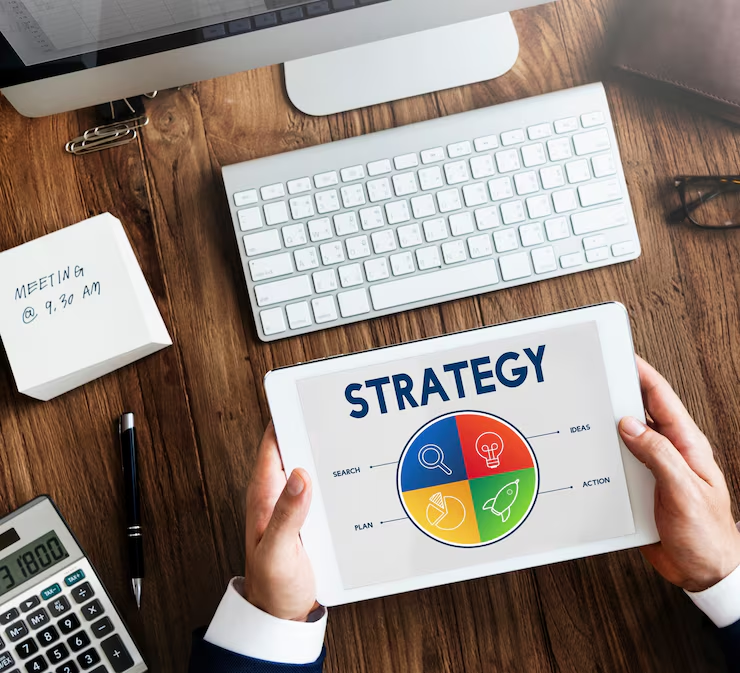
With 15 strategies available, knowing where to start is as important as knowing what to do. The right prioritization depends on your current situation but follows a general order of impact for most businesses.
Start with technical SEO because no other strategy can reach its full potential on a technically broken foundation. Fix crawlability, indexing, speed, and mobile issues before investing heavily in content or link building.
Then build your topical authority structure through pillar and cluster content planning, ensuring every piece of content you create contributes to a coherent authority-building strategy rather than being isolated. Simultaneously optimize your on-page SEO elements across all existing key pages.
As your content library grows, shift focus toward backlink building for your most valuable content pieces and internal linking optimization to distribute the authority those backlinks bring across your entire site. Use Google Search Console continuously throughout every phase to identify quick wins and course-correct based on real performance data.
How Mark X Media Implements These SEO Strategies for Pakistani Businesses
Mark X Media implements all 15 of these strategies for Pakistani businesses through a structured, integrated SEO engagement that covers technical foundations, content strategy, on-page optimization, link building, and continuous performance improvement.
Their approach starts with a complete technical audit, moves through keyword research and topical authority planning, executes on-page optimization across all key pages, and builds the backlink profile and content depth that sustains top rankings over time. Every month, their team reviews Search Console data and performance analytics to identify the next highest-impact optimization opportunities and act on them systematically.
Their content writing services produce the comprehensive, well-optimized content that builds topical authority and earns rankings. Their social media marketing services amplify that content to build the brand signals and distribution that support organic search performance.
For Pakistani businesses ready to dominate Google search in their category in 2026, visit their contact page and arrange a free SEO consultation where their team will review your current search presence and build a clear strategy to reach the top.
Frequently Asked Questions
How long does it take to see results from these SEO strategies?
Technical SEO fixes and on-page optimizations can produce results within weeks. Content and topical authority building typically takes three to six months to show significant organic traffic improvement. Backlink building compounds over six to twelve months. A complete SEO strategy produces its strongest results at the twelve-month mark and continues to improve beyond that with consistent execution.
Which of these 15 SEO strategies has the biggest impact?
Technical SEO foundation, topical authority building, and high-quality backlink earning consistently produce the largest impact when done well. However, all 15 strategies work together as a system. Implementing only one or two produces limited results compared to a comprehensive approach that addresses all dimensions of SEO simultaneously.
Do these SEO strategies work for Pakistani businesses?
Yes. Google’s ranking algorithm applies the same fundamental principles globally. Pakistani businesses that implement these strategies compete effectively not just in local search results but in national and international results for their relevant keywords. The strategies are adjusted for local market specifics like language, local keyword research, and Google Business Profile optimization but the core approach is universally applicable.
How much does SEO cost for Pakistani businesses?
SEO costs vary based on the competitiveness of your industry, the current state of your website, and the scope of work required. Mark X Media offers flexible SEO packages for Pakistani businesses at different stages of growth. The best way to understand the right investment for your situation is to arrange a free consultation with their team.
Can I implement these SEO strategies myself?
Many of these strategies can be partially implemented by a motivated business owner with time and willingness to learn. However, the technical depth, content quality, and link building relationships required to dominate competitive categories typically require professional expertise and dedicated time that most business owners cannot realistically provide alongside managing their core business. A professional SEO agency produces faster, stronger, and more consistent results.
How do I get started with Mark X Media for SEO?
Visit their contact page, share your website and business goals, and their team will arrange a free consultation to review your current SEO performance and recommend the right strategy to dominate Google search in your specific market.